
Circle Talk Blog News, Announcements, Ideas
Incorporating Aboriginal Wisdom to Promote Ecoliteracy 07 Apr, 2016 | Posted by: june
Ecological sustainability is a goal of many Canadian organizations and professionals, including nurses. The most logical source of sustainability wisdom that promotes ecological wholeness are traditional Aboriginal teachings and philosophies. Nursing educational programs are beginning to incorporate Aboriginal wisdom into curriculum to promote holistic nursing care of First Nations, Metis and Inuit people and to help evolve ecoliteracy. Nursing faculty follow a mandate to teach students to be active agents of advocacy for global issues including environmental health and ecology.
This Pechakucha by June Kaminski addresss how students create content to help nurses explore ecological issues and engage in the process of finding solutions to critical issues, and how Aboriginal wisdom supports this. It also explores how the Canadian Nurses for Health of the Environment encourages all Canadian nurses to become involved in promoting ecological sustainability on a national level.
Thirteen Indigenous Grandmothers16 Feb, 2014 | Posted by: june
How Wolves Change Rivers16 Feb, 2014 | Posted by: june
As long as the Grass May Grow....08 Feb, 2013 | Posted by: june
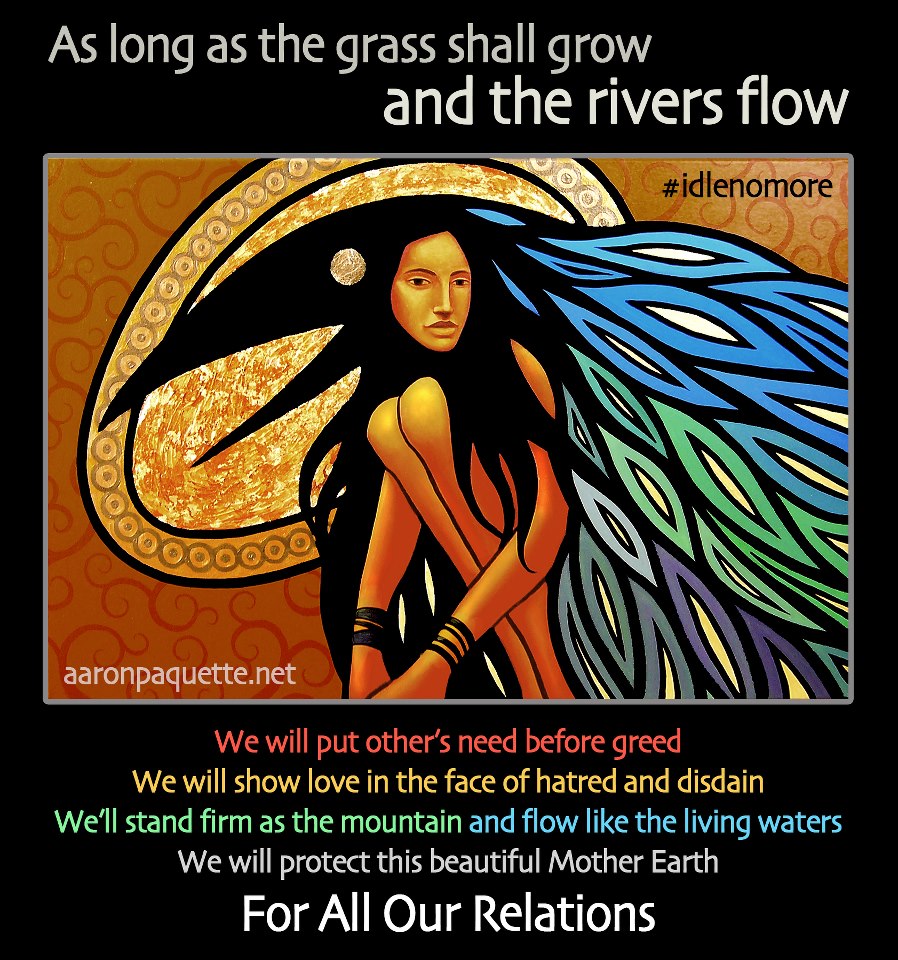
Copied by permission from First Nations Canadian artist extraordinaire, Aaron Paquette:
"As long as the grass shall grow and the rivers flow..."
The poetry of this phrase of Treaty always struck me as uncommonly beautiful.
As does the truth of this statement:
We Are All Treaty.
For those who don't know, Treaties were made between Canadian First Nations groups and The Crown, which is to say, the authority from which each successive Canadian Government derives their authority to rule.
They were intended as a peaceful resolution to a problematic conundrum: how to form a country in a land peopled by Aboriginal groups who could not be defeated on the field of battle?
For the Indigenous population, it was an opportunity to return to a more stable way of life, unmolested by the European invaders who they once protected as friends but now fought with for the right to live.
As we saw with the Residential School horror, that peace was not to last.
For the past century and more, Indigenous groups have witnessed the encroaching of their lands, the theft of their resources, and the reneging by the government of monies agreed on in return for peaceful use of the land.
There used to be a fund set aside. Corporations could extract resources from Treaty lands. They would keep 60% of the value and the landlords, the First Nations, would get 40%.
(almost done the history, bear with me!)
Canada's first Prime Minister, John A. MacDonald, wanted to build a railroad...but how to pay for it?
You guessed it. That fund was dissolved. And lo! the railway was born!
And the taxpayer was given the responsibility of taking care of the corporation's debt to the Treaties. And even then, it was a pittance compared to what was actually due.
If we add up the money that is owed, there is a Trillion Dollar Debt to the children of Canada's treaties, many of whom have no clean drinking water, no warm shelter for the cold winter months, and no access to decent education and healthcare (all part of the original Treaty Agreements, by the way).
And in the meantime, the government has been trying to rid itself of the "Native Problem" through attempted Genocide, assimilation, and reduction of funds to "starve them out".
No one in the general public really complains because at the same time, there has been a public continuation of some popular memes, propaganda if you will:
The natives are lazy.
The leaders are corrupt.
The problem with the natives is the natives themselves.
Everyone suffers, why should they be special?
It's in the past, forget about it.
As long as people believe these obvious untruths, the government has free reign to continue their work of dehumanizing their enemy and chipping away at the treaty lands for corporate use.
Why is this important?
Because those lands have been instrumental in keeping Canada a natural paradise. This is why we are all Treaty. We all share that responsibility.
This isn't just a Native thing, this is an Everyone thing. We are all in this together.
The beauty of our unspoiled places, that they have been kept pristine and clean for this long is a miracle.
And we want to keep it that way.
All our children deserve it.
The Treaties make this possible, and its what the government wants to be rid of so that those lands can be developed.
And the waters are now unprotected.
It's easy to do the math.
All you have to do is see who profits.
I'm not anti-corporation at all. But I am all for a responsible stewardship of the land we all share. The water we all drink, and the air we all breathe.
As long as the grass shall grow and the rivers flow...
First Nations in Canada have been good allies for the rest of Canada.
In every instance they have come to the table in peace. In every instance they have operated in good faith.
There is a misconception that they are always asking for more. They are only asking for the Government of Canada to live up it's share of these Peace Treaties.
There is a misconception that all the Chiefs are corrupt and the meagre sums provided have been mishandled. The office of the Minister of Aboriginal Affairs has to approve every cent of expenditures. Myth destroyed.
Canada's Indigenous people have been very patient. They have been purposely kept in a state of poverty and emotional wreckage in order to control them.
But the new generation is rising. They have been freed from the cycle of abuse and they are educated. They are supported by the wisdom of their Elders. And they are tired of this long, long, fruitless fight. They want peace and fairness.
And so should you.
You should be proud that you live in this time when the broken pieces of the past are being gathered, put back together.
You live in a time when an abused people are reclaiming their dignity and strength. And they don't carry blame, they don't carry guilt, they carry an olive branch.
And the settler's legal books, which they have read and mastered.
Canada is sadly a deeply racist society and that is now being uncovered.
Be happy and overjoyed! The light will cast out the darkness.
You are witnessing a Civil Rights Movement that is lighting the world up with inspiration.
And you are invited to join it. You are invited to be part of what will be the remaking of Canada's present and providing a better future not only for one of the largest landmasses in the world, but for the world itself. This is only the beginning and it's time is due.
The time is now.
And you are here.
It can't happen without you.
You're here for a purpose. To be a part of something wonderful.
You can feel it.
And you can feel the fear of the establishment. They don't want change. But change is coming. Peacefully.
It's time to put this broken world back together again.
hiy hiy
by Aaron Paquette
http://www.aaronpaquette.net/
https://www.facebook.com/AaronPaquetteArt
Our Sacred Trust....08 Feb, 2013 | Posted by: june
DAKOTA 38 - Full Movie in HD 08 Feb, 2013 | Posted by: june
PREFACE TO THE FILM:
In the spring of 2005, Jim Miller, a Native spiritual leader and Vietnam veteran, found himself in a dream riding on horseback across the great plains of South Dakota. Just before he awoke, he arrived at a riverbank in Minnesota and saw 38 of his Dakota ancestors hanged. At the time, Jim knew nothing of the largest mass execution in United States history, ordered by Abraham Lincoln on December 26, 1862. “When you have dreams, you know when they come from the creator… As any recovered alcoholic, I made believe that I didn’t get it. I tried to put it out of my mind, yet it’s one of those dreams that bothers you night and day.”
Now, four years later, embracing the message of the dream, Jim and a group of riders retrace the 330-mile route of his dream on horseback from Lower Brule, South Dakota to Mankato, Minnesota to arrive at the hanging site on the anniversary of the execution. “We can’t blame the wasichus anymore. We’re doing it to ourselves. We’re selling drugs. We’re killing our own people. That’s what this ride is about, is healing.” This is the story of their journey- the blizzards they endure, the Native and Non-Native communities that house and feed them along the way, and the dark history they are beginning to wipe away.